

VAT Filing Guide 2026

VAT Filing in Dubai: Complete UAE Guide for 2026
If your business is VAT-registered in Dubai, filing your VAT return is not optional. You must submit the return electronically through EmaraTax and settle any payable VAT by the deadline set for your tax period. In the UAE, the key numbers still matter: mandatory VAT registration starts at AED 375,000, voluntary registration starts at AED 187,500, and VAT returns are generally due within 28 days from the end of the tax period. Since January 2026, the UAE has also introduced VAT-law amendments around reverse-charge documentation, reclaim time limits, and input-tax controls.
For Dubai businesses, the main trap is assuming “free zone†means “no VAT.†That is too simplistic. The UAE VAT framework distinguishes between ordinary free zones and designated zones, and even then the treatment depends on the type of supply, especially for goods. The safest practical rule is this: if you are VAT-registered, assume you need to review and file correctly unless a clear rule says otherwise. That matters whether you run a mainland consultancy in Business Bay, a trading business in Jebel Ali, or an e-commerce operation using Dubai Airport Free Zone or Dubai CommerCity infrastructure.
Who Needs to File VAT in Dubai
Any business that is already registered for VAT must file a VAT return for every assigned tax period, even when activity is low and even when no tax is ultimately payable. The FTA registration thresholds remain AED 375,000 for mandatory registration and AED 187,500 for voluntary registration. Your actual filing period is assigned by the FTA inside EmaraTax. Many UAE practitioner guides say most businesses file quarterly while larger businesses can be assigned monthly periods, but your operative reference should always be the tax period shown in your FTA account.
A practical Dubai example helps. If a mainland marketing agency in Dubai bills local clients and crossed the mandatory threshold, it must register and file. If a Jebel Ali goods trader operates inside a designated zone, the VAT treatment may differ for certain goods movements, but that does not mean the company can ignore VAT compliance. Likewise, a company in a Dubai free zone that meets the registration conditions must still assess its VAT obligations and file where required.
VAT Filing Deadlines & What Changed in 2026
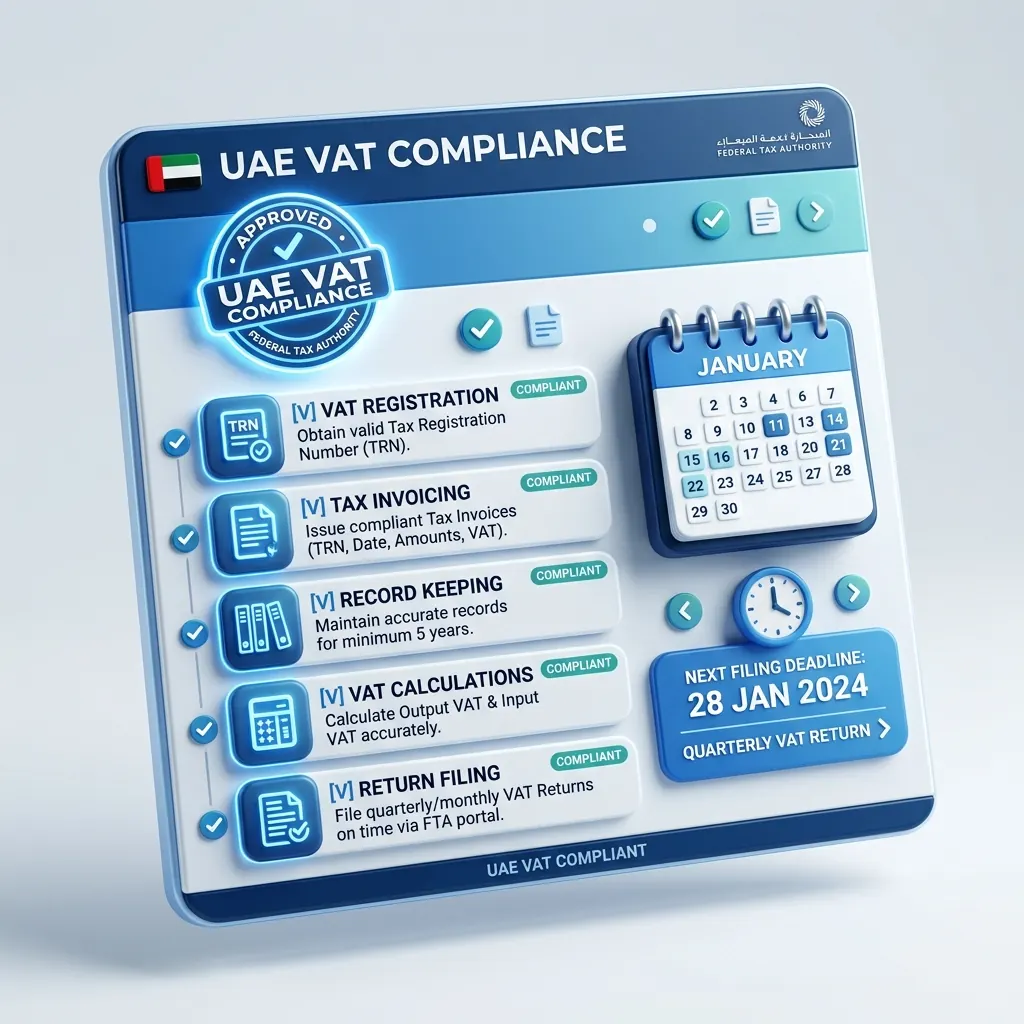
The baseline deadline is simple: the return and any payable VAT are due within 28 days from the end of the tax period. For a standard quarterly cycle, that usually means:
- Q1 (Jan–Mar) → due April 28
- Q2 (Apr–Jun) → due July 28
- Q3 (Jul–Sep) → due October 28
- Q4 (Oct–Dec) → due January 28
Two 2026 changes deserve their own checklist item. First, under the January 2026 VAT-law amendments, taxpayers using the reverse charge mechanism are relieved from self-invoicing, but they must still retain supporting documents as required by the Executive Regulation. Second, there is now a five-year limit for reclaiming excess refundable tax after reconciliation. The Ministry of Finance also said the FTA may deny input-tax deduction where a transaction is part of a tax-evasion arrangement, which raises the importance of supplier due diligence and document hygiene.
Step-by-Step VAT Filing on EmaraTax
Start by gathering the records for the relevant period: sales invoices, purchase invoices, credit notes, customs documents where applicable, and your internal VAT reconciliation. Then log into EmaraTax and open the VAT return for the assigned period.
A clean process for a Dubai business usually looks like this:
- Prepare your numbers: Separate standard-rated sales, zero-rated sales, exempt supplies, and recoverable input VAT. Make sure you have valid tax invoices. The FTA VAT return guide explicitly warns against including non-business costs or disallowed expenses.
- Open the VAT 201 form: Access the return through the VAT section of the EmaraTax portal. Review the period reference carefully before entering amounts.
- Enter your output VAT: Report standard-rated sales and output VAT in the correct sections. Specify zero-rated or exempt transactions accordingly.
- Enter recoverable input VAT: Only claim what is properly recoverable. Purchases tied to exempt or non-business activities are disallowed.
- Review and submit: Save drafts while you work, check mandatory fields, confirm the declaration, and submit. Settle any liabilities immediately to avoid late payment charges.
A Simplified Sample VAT Return for a Dubai Business
Here is an illustrative example of a quarterly VAT 201 return for a Dubai mainland consulting company:
Penalties Every Dubai Business Should Know
Outdated penalty guidelines from previous years can lead to costly errors. Under Cabinet Decision No. 129 of 2025, effective from 14 April 2026, the updated penalty structure is as follows:
-
Late Submission of a Tax Return:
AED 1,000 for the first offense; AED 2,000 for repeated failure within 24 months.
-
Failure to Settle Payable Tax on Time:
A monthly penalty of 14% per annum (pro-rated) applied on the unsettled payable tax amount from the day after the due date.
-
Incorrect Tax Return:
AED 500 fixed penalty (unless corrected within the allowed window or corrected without changing the due-tax position).
Dubai Mainland vs. Free-Zone Examples
If you run a mainland Dubai services business, your primary filing challenges lie in supply classification, invoice layouts, and input-tax recovery discipline. If you run a free-zone goods business, you must check if your zone is defined as a designated zone by the FTA.
The FTA's official list of designated zones in Dubai includes Jebel Ali Free Zone (JAFZA), DAFZA Industrial Park – Al Qusais, Dubai Airport Free Zone, and Dubai CommerCity. Moving goods into or between these zones requires distinct documentation to qualify for VAT exemptions, whereas services provided within designated zones are usually subject to the standard 5% VAT rate.
Need Expert VAT Filing Support in Dubai?
Avoid penalties and ensure 100% compliance with current Cabinet decisions and FTA regulations. Let Exiloz handle your bookkeeping cleanup, VAT calculations, and EmaraTax filings.
Frequently Asked Questions
Do I need to file a VAT return if my Dubai business had no transactions this quarter?
Yes. If you hold an active VAT registration, submitting a "Nil return" is mandatory for every period assigned to you by the FTA.
What is the VAT registration threshold in the UAE?
Mandatory registration is required when taxable supplies and imports exceed AED 375,000 in the past 12 months. Voluntary registration is available at AED 187,500.
When is the VAT return due?
It is due within 28 days following the end of your tax period (monthly or quarterly), as assigned on the EmaraTax portal.
What if I filed my VAT return incorrectly?
You can submit a Voluntary Disclosure (VDF) to correct errors. Correcting it before the audit or settlement deadline reduces liability risks significantly under the 2026 guidelines.
